_ The mystery of form is one of nature’s deepest secrets. It has attracted some of the greatest minds, both scientific and artistic, from Aristotle through Leonardo and Durer in the Renaissance, to Alan Turing in the 20th century.
Form and pattern are the natural meeting place of art and science so why is it that we don’t know more about this magic land where the lion of science lies down with the lamb of art? The reason is the strange status of form in science – its relative neglect. Darwin wrote of ‘Endless forms most beautiful’. But he knew nothing of the processes that created these forms: natural selection is a sieve of possible forms, not the generating mechanism itself.
It is only in the last 30 years that biological pattern-making has come of age. But, as with every subject, there is a pre-history. There are unsung pioneers.
The undisputed prophet of biological form is D’Arcy Wentworth Thompson (1860-1948). Thompson was a great Victorian, Scottish polymath. I say Victorian although he died in 1948. But everything about Thompson was redolent of 19th century genius. He was a mathematician and a classicist as well as a biologist. He was regarded as being outside the biological mainstream until the new science of biological form, evo devo, took off in the 1980s. Thompson didn’t like the indirectness of Darwinian natural selection. He thought that physical forces acted directly on living things to shape them.
He showed how soapy foams template the intricate geometrical forms of the marine creatures, radiolarians. There is a whole geometry that connects soap bubbles, the radiolarians, bees’ honeycombs, the football, Buckminster fuller’s domes and the C60 molecule named after Fuller: buckminsterfullerene. And Thompson was the first to demonstrate it.
The second great prophet of morphology is the mathematician and computer pioneer Alan Turing. In 1952 almost nothing concrete was known about the biological mechanism of pattern formation but the problem interested one of the greatest minds of the century. Like D’Arcy Thompson, Turing noticed patterns in living things that could be explained by physical processes.
Long before chaos theory, Turing showed mathematically how chemicals diffusing through biological tissue and reacting could become unstable and lead to complex patterns such as the markings on snail shells, leopards, jaguars, giraffes, and Friesian cattle.
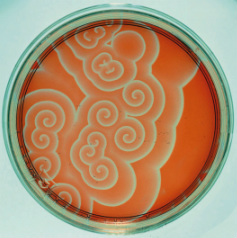
Many of the patterns in nature can be generated by algorithms, equations that feed back in to themselves. In nature it is not equations that feed upon each other but systems of activation and inhibition. You can see this in a purely chemical reaction – the Belousov-Zhabotinsky reaction – that produces ever changing patterns. Some of these patterns can also be seen in nature, for example in slime moulds. The convergence of mathematics, chemistry and natural forms demonstrates a powerful principle that governs all pattern formation.
This convergence also embraces art. Thompson saw parallels between natural processes such as the formation of gourds and technical processes like glass blowing: in each the shape results from an interplay of physical forces. So D’Arcy Thompson regarded beauty as the product of graded curves that shift in a smooth manner from one radius to another. He wrote:
“The Florence flask or any other handiwork of the glassblower is always beautiful because its graded contours are, as in its living analogues, a picture of the graded forces by which it was conformed. It is an example of mathematical beauty.”
Then there’s Sir Ernst Gombrich, a great art critic who found parallels between natural and human creativity: he wrote beautifully on mimicry and what nature’s copying and stylized warnings mean for the art of human beings: “For the evolution of convincing images was indeed anticipated by nature long before human minds could conceive this trick . . . the art historian and the critic could do worse than ponder these miracles. They will make him pause before he pronounces too glibly on the relativity of standards that make for likeness and recognition.”
Gombrich finds various styles of art in nature: a leaf butterfly can fancifully be considered to be “a naturalistic artist,” natural selection having produced a facsimile of the dead-leaf pattern. But the eyespots sported by some butterflies are stylized gestures: “They represent, if you like, the Expressionist style of nature.”
The study of beauty in nature and human art is suddenly a live subject again. I have written about parallels between art and nature in The Gecko’s Foot and Dazzled and Deceived. Philip Ball brilliantly brings D’Arcy Thompson up to date in Shapes, one of three volumes spun off from his magisterial survey The Self-Made Tapestry: Pattern Formation in Nature. In 2009 The Fitzwilliam Museum in Cambridge mounted a seminal exhibition on Darwin and the visual arts, which produced a sumptuous volume: Endless Forms: Natural Science and the Visual Arts. And now in Survival of the Beautiful David Rothenberg surveys the field of nature’s artists, finding parallels between abstract art and the patterns of creatures such as the bower birds and squid.
Somewhere to the side of the Saatchi/Turner/Hirst/Emin axis, a new force in visual art is stirring.
Some of the strangest creatures on earth have recently shed new light on nature’s mysterious pattern forming programmes. The discovery of the hox genes in the 1980s was the first breakthrough in understanding how the forms of all creatures are made and how they evolved. All animals, whether insects or mammals, are highly modular: evolution has occurred through copying of modules with subsequent modification of what were once identical parts (homology). So all insects have segments and all land animals have four legs (tetrapods). These programmes seem to be highly constrained and conservative. Birds are tetrapods and whilst it might be advantageous for a bird to have four legs and two wings, evolution has not managed this: the forelimbs can become wings but extra limbs cannot be achieved. In fact, it hard to know how true novelty ever emerged.
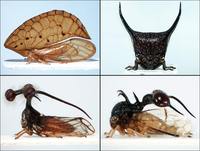
In a recent paper in Nature (2011, Vol 273, pp83-86) a French team have shown that there is an exception to every rule. Primordial insects might have had wing-like appendages on all the segments but long ago the hox gene suppressed wings on all but two segments: the second and third thoracic segments. The treehoppers have astonishing varied appendages, “helmets” which may be used for camouflage or to break up the creature’s outline or in some cases to form protective spines. The range of these helmets in different species is so vast and grotesque that the creatures look like sci-fi aliens. Benjamin Prud’homme and Nicolas Gompel’s team has shown that these weird shapes are actually formed by the normal wing hox genes but acting on the head segment, a place where they are suppressed in ever other species of insect. They say that this is an unprecedented example in 250 million years of insect evolution. And beyond that, the helmets show what nature pattern forming genes can do when they have a free hand.
Wings have to obey the laws of aerodynamics so they are constrained in the forms they take but these helmets can take pretty any form they like, although they obviously fulfil some function. The pattern forming genes work by switching on an off in cascades, accelerating growth in one area, slowing it in another. The results are breathtaking.
The helmets are not variations on a theme but a complete gallery of morphs. Some seem to be mimicking other creatures such as ants; one would make a rather cool arced earring; one is a leaf mimic, and so on.
In the technological realm we now have 3D printers, using stereolithography to build, layer by thin layer, any pattern you like, laid down by a computer design. The pattern is built by resin deposition in accord with the parameters laid down by the computer programme. The treehopper seem to foreshadow nature’s stereolithography by means of hox genes.
In Dazzled and Deceived I investigated the genetic patterns behind mimicry and camouflage. Almost all of this work had been done on butterflies; Prud’homme et al have begun the process of unlocking the treasure trove of mimetic pattern-forming in the wider natural world.
Credit: B. Prud'homme et al., Nature, 473 (5 May, 2011)