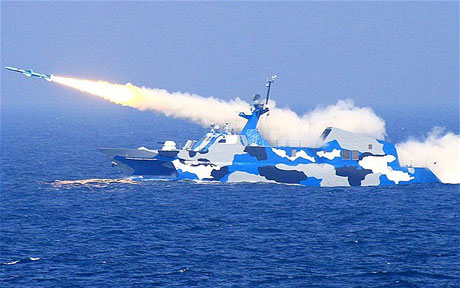
Dazzle painting of ships hasn't been much used since World War I (see Dazzled and Deceived) so it was a surprise to see a rather beautiful version on a Chinese missile ship test-firing its hardware recently. Add Comment In Dazzled and Deceived, a key theme was the search for effective ships’ camouflage. It began with the eccentric American artist Abbott Thayer at the turn of the 20th century. Thayer had discovered the law of concealing coloration in nature in 1896 (ie animals are dark on top and pale below to counter glare and shadow and make the outline harder to pick out) and became obsessive in his attempts to convince the military to camouflage ships in the same way. He failed and died in despair in 1922 But in my research I discovered that the naturalist Peter Scott, a naval commander in WW2, had introduced a Thayer-like system of camouflage. He’d read Thayer as a boy, camouflaged his own ship in a freelance manner, and then convinced the Admiralty to adopt it as the Western Approaches colour scheme. The documentation was thin and I sought official confirmation in the National Archive and The Imperial War Museum archives. Nothing could be found. Then I found a reference to a naval document – CB3098 – in David Williams’ Naval Camouflage 1914-1945. It seemed that the Admiralty had posthumously acknowledged Thayer after all. I had to get that report. But although the National Archives had the CB series, 3098 was missing. As so often, the net came to the rescue. Bizarrely, it turned out that a Shropshire modellers’ cottage industry sold a facsimile of CB 3098 – The Camouflage of Ships at Sea – to enable modellers to paint their model ships in authentic colours. The report did indeed vindicate Thayer. Given the crushing rejection he had received, the report’s conclusions are astonishing. How Thayer – long dead – would love to have heard these words: “…during the early part of the 1914-1918 war, a number of schemes for reducing the visibility of ships at sea were submitted to the Admiralty. …The soundest of these proposals, whose best points are incorporated in present-day camouflage practice, came from an American artist, Abbott H. Thayer, and from a British biologist, Professor (now Sir John) Graham Kerr; both based their arguments primarily on their observations of the concealing colouration of wild animals and the two sets of proposals were to some extent complementary.” What could have caused this amazing volute face? The report goes on to say that Thayer and Kerr’s argument that “white is the tone for concealment on an evenly overcast grey day – has been thoroughly vindicated in the present war by the Western Approaches, the scheme of camouflage designed by Lt-Cdr. Peter Scott, MOB’S.., R.N.V.R.” The suggestion is that Scott’s inside knowledge of naval operations helped him to carry conviction where the outsiders had failed. The report notes of Thayer and Scott: “it is interesting that the two men who arrived independently of each other, and at an interval of 25 years, at this same unorthodox conclusion should both have brought to the solution of the problem the imagination of an artist and the eye of a practised observer of nature”. Thayer’s odyssey was convoluted in the extreme, as was the research trail in his wake. You start to write a book because a subject has grown till it fills a book-sized space in your mind. Fine, but once you start you’re aware that there are many gaps in your knowledge. A book is forever, you hope, so you’d better fill those gaps. I became interested in mimicry over 25 years ago when I was editing natural history encyclopedias.There was just something uncanny about the idea of one creature impersonating another, especially when it was an animal trying to look like a plant. There’s a bug, Ityraea, that collects on twigs en masse and looks like a convincing flower spike until they all get up and drop off the twig; the leafy sea dragon has tattered appendages to its fins that exactly mimic the sea-weed it lives among; the Kallima butterfly has gorgeously rich purple and organ wings: when they’re open, that is; closed the underside is dead-leaf brown, complete with mouldy bits and holes and it even mimics the leaf stalk. But I didn’t want the book (now Dazzled and Deceived: Mimicry and Camouflage) to be simply a catalogue of these stupendous creatures, one after another. The bible of the subject was Hugh Cott’s Adaptive Coloration in Animals and I knew that Cott had served as a camouflage officer in World War II, as had some painters. I wanted to see how camouflage and mimicry played out in human affairs as well as nature. Long before Velcro, camouflage was the first great bio-inspired technique. This wartime research took me to the National Archives at Kew and the Imperial War Museum, where I spent many happy hours. The Desert War in North Africa in World War II began to fascinate me. Seeing reports in the archives, written on old typewriters in the desert, the files now slowly rotting in the archives was deeply thrilling. The Imperial War Museum has many accounts lodged by ordinary serving forces personnel and I combed these for accounts of the camouflage operation in North Africa. This of course was totally needle-in-haystack but I struck lucky. Reading the file of Sergeant Bob Thwaites, the camouflage school in the desert suddenly loomed into view. Thwaites had a very pithy take on forces life: Our first acquaintance with our instructor was not encouraging. We had been told he was one of Britain’s most eminent naturalists and appeared to have been dragged protesting from a twitcher’s hide, bundled into a captain’s uniform made by a blind tailor and posted to Maadi. This was vivid writing and, even better, this had to be my man, Hugh Cott, he was writing about: He was middle-aged, balding and with a military bearing suggesting that he could well have thought Sandhurst to be a seaside resort. But, according to Thwaites, Cott won them over with an eye-opening list of camouflage tricks and insights including how to get your bearings from churches, why cowboy jackets are fringed and how many animals don’t just look like something else, they behave like it: such as the bittern which if disturbed sways like the reeds it is trying to emulate. For Thwaites it was an exercise in lateral thinking; for me it was manna from heaven. The patterns we make as we criss-cross each other’s lives are infinite and most of them are hidden. Go seek and you will find treasure. The obituary notices for the test pilot Peter Twiss brought back a lost world of British aviation. Twiss broke the world air speed record when he flew the Fairy Delta 2 at 1132 mph on 10 March 1956. British aviation, like British science and technology generally, had entered the post-WW2 era on a par with the USA in most departments but a series of catastrophic bungles reduced us to the condition we are in today. We no longer have the capacity to make a complete aircraft – we only do bits. The FD2 saga is perhaps the most appalling. Not only were the Ministry of Defence not impressed by Twist’s feat, they were so incensed by the barrage of damage claims from sonic booms that they banned supersonic test flights. Twiss took the FD2 to the French Dassault airfield. The great plane maker Marcel Dassault was very impressed by the FD2 and the classic Mirage 3 shows clear signs of FD2 influence. In 1957 the British Defence Minister, Duncan Sandys, cancelled all manned fighter projects other than the English Electric Lightning. Missiles would take over, he said. Only now are drones beginning to usurp manned planes. The last 50 years have been the age of the fighter bomber and few have been as successful as the Mirage 3. The whole story is beautifully told in James Hamilton-Paterson’s Empire of the Clouds. On 27 Jul 2011 William Hague officially recognised the Libyan opposition as the legitimate government and pronounced upon” the national transitional council's increasing legitimacy, competence and success in reaching out to Libyans across the country.” Two day later Abdel Fatah Younis, the military chief in the rebel Transitional National Government, was shot dead in murky circumstances. Just what evidence was there for this “increasing legitimacy, competence and success”? When John Reid, as Defence Secretary, sent British troops to Afghanistan in 2006, he said that “I hope not a shot is fired”. QED. There seem to be two wars in Libya: the one you know about and another one between the USA and NATO. When the US handed over control to NATO and withdrew most of its active forces, Senator John McCain pointed out that NATO did not have the right hardware for the operation. They lacked ground attack planes such as the A10 tankbuster and the Hercules gunship. Now, several months later, NATO is indeed struggling for lack of the right equipment. Robert Gates, in Brussels the retiring US Secretary of State for Defense was publicly derisive of NATO. He said that NATO was only delivering 150 sorties a day instead of the 300 planned for. The British forces have expressed their frustration with the Americans for withdrawing the A10 tankbusters. So what is going on? The USA seems to be trying to make a point. By withdrawing and then publicly criticising the European efforts they seem to trying to press home an old political point: that Europe should shoulder more of the burden in Nato. But it seems a particularly distasteful way to do it: whilst the war is being prolonged and people are dying. But Europe doesn’t come out of it much better. Why is their equipment so inadequate? It has been obvious for at least 20 years (since Gulf War I) that this kind of operation was the most likely combat European forces would see in future. But there is a severe lack of ground-attack capability. The Eurofighter Typhoon has had to be clumsily converted to a ground-attack role. All of the planes involved are firing expensive missiles such as the Paveway to destroy individual tanks, a ridiculously expensive overkill. As for the Navy’s Tomahawks cruise missiles at £½ million a wasted shot….So expensive is it that the operation cannot continue for much longer, according to the British forces (stat: the UK has the 4th largest defence budget in the world). When complete air superiority is obtained, cruder and less expensive anti-armour weapons can be used (if you’ve got any). The whole affair is an embarrassment to us and a tragedy for the Libyans. There’s a stopped clock on my local tube station with a notice pasted over it, saying “This asset has been decommissioned”. It’s been there for months, waiting for the operative who hung this asinine notice to come and do the deed and put the dead clock out of its misery. Then there was Senator John McCain saying of the US military’s backseat role in Libya: "It's too bad and I would love to see our assets back in the fight." He wasn’t talking about stopped clocks but from NATO’s pathetic performance since that US step-back he might as well have. Why would anybody call an A10 tank buster plane an asset? Partly, for the same reason passengers on trains are now called “customers” or hospital patients “clients”. It is managerialism run riot. In military matters, the reason is creepier: it is to obscure the fact that these weapons kill people (“collateral damage” comes from the same stable). But what earthly purpose is served by a doctor calling an expectant mother by the dehumanizing appellation “client”? Civilization progresses by way of finer and finer distinctions. If you start to reduce the distinctions between different things, there is a loss of sensitivity of understanding. There are perhaps 2-30 million living species on the plant but, hey, why bother with names, let’s just call them all “bioforms”. Again, perhaps the rise of the “asset” reflects a society dominated by bean-counters. Whatever the reason, it should be resisted. These “assets” are dead liabilities. A piece in Ian Jack’s The Country Formerly known as Great Britain (p.143) reminds me that Field Marshal Wavell (1883-1950), published a popular anthology of poetry in 1944 called Other Men’s Flowers. This had a certain novelty value and the book’s continuing sales success (still in print today) may owe something to the surprise factor. The contents are the predictable canon of safe, mostly pre-1900 poetry – the kind that a stiff-upper-lip English military man might like. Wavell is generally regarded as bit of a flop: an old-fashioned soldier. He was not a charismatic war leader and was replaced by Montgomery before the crucial battle of El Alamein. Wavell might have been an awkward stick and his taste in poetry uninspiring but he had one flash of pure genius: on 23 April 1941, he had scribbled a note, a facsimile of which is preserved in the War Office files: Is it a wild idea that a tank could be camouflaged to look like a lorry from air by light canvas screens over top? It would be useful; during approach march etc Please have it considered. This was more than considered it was implemented as the Sunshield and hundreds of them were used in elaborate decoys before the great battle of El Alamein. Sunshields were erected and at night tanks moved into position under them. Where the tanks had been, they were replaced by dummies. Churchill didn’t have much time for Wavell: meeting him was like “being in the presence of the chairman of a gold club”. But when the battle was won, Churchill paid tribute to “a marvelous system of camouflage”: “The 10th Corps, which he [the enemy] had seen from the air exercising fifty miles in the rear, moved silently away in the night, but leaving an exact simulacrum of its tanks where it had been, and proceeded to its points of attack.” The story of Wavell and the Sunshields and other war ruses is told in Dazzled and Deceived. Libya has caught the RAF on the hop. In the cuts, most of the Tornadoes and all the Harriers were to be stood down, leaving the Typhoon as the prime front line aircraft. But the Typhoon was designed as an interceptor and there have been no dogfights in Libya – attacking tanks and other armour on the ground is the task. The Eurofighter, expensively designed as a state of the art dogfighter, was already in the process of being clumsily adapted for ground attack because the RAF's designated ground attack plane, the US F35 Joint Strike Fighter is late and won’t be here for several years. It has been obvious, at least since the Gulf War in 1991, that in most likely combats ground attack is vital and dogfights more or less a thing of the past. Yet the government persisted with a policy that created this enormous hole in the RAF’s capability. James Hamilton Patterson's magnificent Empire of the Clouds – how Britain lost its once great aircraft industry – reminds me that we’ve been her before. In 1945, the government decided that no new fighter plane would be needed till 1957. Within 5 years they were fighting the Korean War and had to buy 428 (yes 428!) Canadian-made versions of the US F86 Sabre. There followed an appalling tale of cancelled projects, every botch-up unimaginable, from then on, up to the Typhoon disaster. Perhaps naming the Eurofighter Typhoon was a jinx? The first Typhoon, the Hawker plane of the second half of WW2 was a fearsome ground attack plane, wreaking havoc on German lines after D Day. Admittedly, the original Typhoon was also designed as an interceptor and adapted but that was easier in the days of string and sealing wax. Today, if you want a ground-attack plane it is better to design one. |
RSS Feed