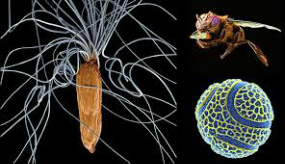
Richard Hammond's Invisible Worlds on BBC1 last night featured bioinspiration. Three key subjcets - the Lotus Effect, spider silk and gecko adhesion - were featured. All first appeared in The Gecko's Foot (2005), still the only popular science book on the subject. Bioinspiration is set to be a key element in the new technologies that will fill the gap left by industrial collapse and the banking implosion.
 
 
Banksy versus Bristol Museum is an obvious media and popular triumph but many seem to want to play down its artistic significance. The show is actually full of surprises and paints Banksy in a new light: the heir to a line that includes Picasso, Sir Ernst Gombrich and the study of mimicry in nature.

How so? One room in the show contains pieces that Banksy could never have mounted on the street: animatronic creatures in caged installations. These include a rabbit surrounded by make up gear admiring herself in front of a mirror and a chimpanzee artist  rocking his head, closing one eye after the other as he sizes up the conventional landscape he is painting. These make telling points about human vanity and they also show how easily an impression of life can be created by a few simple movements: if it twitches it must be alive.

Then there is the animated processed food. Chicken nuggets hatched from eggs are feeding; a salami squirms as if to escape its plastic casing; a mustard-coated sausage in a hot dog sips water. But the most amazing of these living processed food sculptures is the salami in which the thread that tied it to a hanging string is draped to look like whiskers. The cartoon minimalism of this creature is stunning: a craning salami head and a wispy string and, hey presto, it is a walrus. But – the other stroke of genius – the tail of this writhing walrus/salami has already been diced and sliced several times.

It is impossible to look at Banksy’s salami without thinking of the assemblages Picasso created around 1948-51.  Foraging for suggestive junk around rubbish tips in Vallauris, he created a series of sculptures, including a Little Owl who struts on rusty screws for feet, a bull’s horns made from a bike handlebar, and a baboon’s head from two toy cars, placed wheel to wheel.

Whether Banksy was thinking of Picasso’s assemblages when he created these living-food pieces I don’t know but he was certainly thinking of Picasso when he mounted the show. On a plaque inscription he quotes Picasso as saying that “Bad artists copy; great artists steal”, scratches out the attribution to Picasso, and substitutes his own name. There is no evidence Picasso ever said this, although one feels he ought to have. The authentic quote is from T.  S. Eliot (“immature poets imitate; mature poets steal”) but in essence I’m sure that Eliot, Picasso and Banksy are at one on this.

In one piece Banksy surpasses Picasso by using equipment unknown in the 1950s. The contemporary hi-tech equivalent of Picasso’s Little Owl is the CCTV family of a mother and two chicks. Perched on their poles over the motorways, CCTV cameras already look like storks; in the Banksy, a mother CCTV gazes down solicitously on her two tiny offspring. Her head roves back and forth over them; the agitated babies crane up to her, jiggling their beaks for food, as fledglings do. The wit and resonance of this piece – its punning on ideas of surveillance, protection, and maternal care v. Big Brother intrusion – is a triumph.

Such punning visual suggestions were of deep interest to the art historian Sir Ernst Gombrich, who showed how a thread of visual punning ran through cartooning (Banksy is, much of the time, a cartoonist), and advertising, as well as fine art. He highlighted the punning of natural forms and human gestures, as in an 18th century French cartoon which saw the character of Louis Philippe’s face in a pear (a secondary meaning of “poire” in French is fathead, so the cartoon is both visually insulting, in emphasizing the flabby jowly features of the King and a verbal insult). Gombrich commented: “Thus a play on words and a visual joke were happily combined”. Gombrich also noted that nature has equivalents for artistic styles; leaf mimicry is naturalistic but a butterfly’s eyespots “represent, if you like, the Expressionist style of nature”, meaning that the eyespot is a symbolic warning gesture that doesn’t copy anything.

For millions of years before Picasso and Banksy appeared on the scene, creatures have been masquerading as a different kind of thing entirely, either camouflaging themselves against the background like the peppered moth (pale and peppered against lichen in the country; black against soot in the city), or mimicking the form of a stone, a leaf or another creature, as the harmless kingsnakes do, donning the red, yellow and black banding of the toxic coral snakes.

In his two-dimensional work Banksy is expert at pointing up the sad contradictions of human existence: the gross Western tourist couple, grinning inanely and self-admiringly into their camera phones as they are pulled in a rickshaw by a waif of an Asian boy; another waif, lost in a blasted wilderness, sporting an “I Don’t Like Mondays” T shirt. In Banksy’s “menagerie room” at Bristol, in three dimensions, he ranges across the world of animals/food and machines to show that our vaunted gestures are not so grand and that vitality and significant form reside in all creation. Picasso would be applauding and so, I think, would Darwin, who was the first to note the similarity between animal and human expressions.
 
Gecko Update 05/22/2009


Gecko Update

To bring a new technology to mass market can take up to 40 years. When I wrote The Gecko’s Foot (2005), I commented that predicting which bio-inspired technologies would come good and when was the toughest job. Bringing products to market is actually harder than innovating in the first place. The clear frontrunner of the technologies featured in the book has been Lotus Effect applications. The Lotus Effect spawned a new science of super-wetting and super non-wetting materials and new applications that have emerged since the book were featured in my Scientific American article in August 2008. In the last year the greatest strides have been made in gecko adhesion itself. Several labs are working on this and are making great progress.

While I was writing the book, I had the idea of making gecko-like arrays using carbon nanotubes and suggested this to Dr Binqing Wei at Louisiana State University. Unfortunately the nanotube idea is so obvious that many others had drawn the same conclusion: nanotube arrays are now widely used to mimic the gecko and are achieving good results.  Another Chinese team at the universities of Akron, Dayton and the Georgia Institute of Technology has created a nanotube array that mimics the real geckos in the important aspect of having a thicker spatulate end to the very thin fibres. They can create 10-100 billion such fibres per square centimetre. These arrays have strong adhesion when pulled along the line of the object they are stuck to but they release easily when pulled away from the surface, exactly what you want in a reusable adhesive.

The original gecko-array fabricator, Ron Fearing, at University of California, Berkeley, has also now produced an array that mimics the gecko’s directionality, using polypropylene fibre.

One of the most fascinating ideas is to combine the techniques of the two very different creatures with remarkable adhesive properties:  geckos and mussels. Mussel glue sets underwater: it evolved that way because that’s where mussels live. Mussel glue research goes back as far as the gecko’s and in 2007 Philip Messersmith's team at North-western University, Illinois reported ‘A reversible wet/dry adhesive inspired by mussels and geckos.’ They call it ‘geckel’. It sounds an idea almost too good to be true. A gecko-like array of tiny pillars is capped with a synthetic mussel-type polymer. The result works in both wet and dry conditions and maintains its strength for 1000 cycles.

Which technique will win through: carbon nanotubes; geckel or directional polypropylene arrays? Or maybe all or none of the above? What is clear is that gecko’s foot adhesives have reached a very interesting  stage of their career.


Google Analytics Yahoo